

- Home >
- About Us >
- Corporate Governance and Internal Control >
- Internal Control : Risk Management
Internal Control
Risk Management
Basic Recognition
To ensure sound and proper business operations and to ensure that we fulfill the obligations arising from our insurance policies, we identify and evaluate potential risks, take appropriate action based on the specific characteristics of each risk and comprehensively manage those risks. We are committed, on a company-wide basis, to improving soundness through the management and control of risk levels and capital.
We have also established a crisis management system and a risk management system to respond to catastrophes and large-scale disasters in addition to our everyday risk management system.
Risk Management Policies and Regulations
Our Basic Internal Control Policy includes our basic philosophy and policies regarding risk management. The approach used to manage each type of risk is developed in line with our series of Basic Risk Management Policies. In addition, each of the risk management regulations and standards is translated into practical rules, following our series of Basic Risk Management Policies.
Risk Management Structures
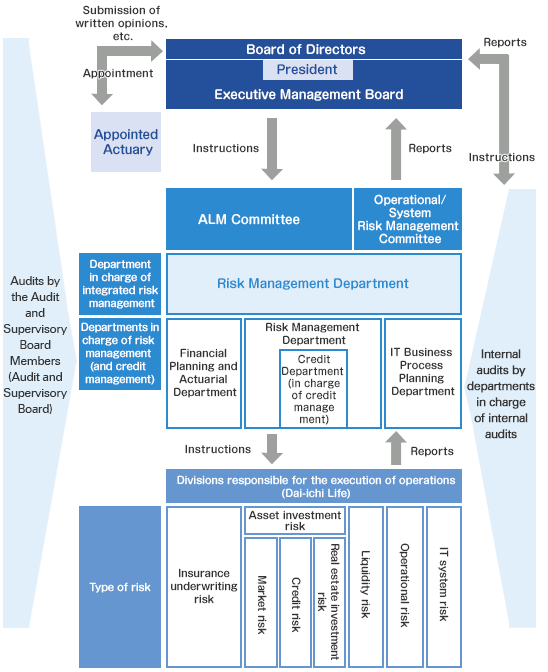
For the various risks arising from the Company's business operations, each responsible department establishes a framework to monitor and check business execution by risk category, in accordance with the relevant Basic Risk Management Policies. In addition, the Risk Management Department oversees and manages risks comprehensively on a company-wide basis.
We have established the ERM Committee, Operational Risk and System Risk Management Committee, which are convened on a regular basis. Through these committees, management reviews and discusses important matters related to risk management. The status of risk management is reported regularly to the Board of Directors and the Executive Management Board. Our Internal Audit Department examines the effectiveness and appropriateness of our risk management framework.
In addition our Audit and Supervisory Board Members conduct audits covering the overall risk management, including that of management.
Promotion of ERM
The Daiichi Life conducts enterprise risk management (ERM) whereby it undertakes its business activities based on business plans, capital strategy, that reflect the current situation regarding capital, risk, and profits.
The Risk Management Department assesses the suitability of business plans, capital strategy, formulated as part of ERM, and also seeks to improve risk management while also controlling capital, risk, and profits in an appropriate manner based on the presence, nature, and characteristics of risk through activities such as setting and managing margins for risk.
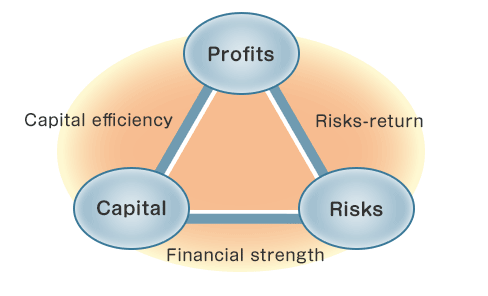
The Company appropriately manages its financial soundness by integrating various risks from the perspectives of economic value (for both regulatory and internal management purposes) and accounting, and comparing it with our capital position.
To identify and evaluate aspects that are not captured by the model-based quantification of risk, stress testing is conducted using worst-case scenarios based on possible future events or actual past events, such as financial market panics or large natural disasters. This is then used as a basis for analyzing the factors that influence the integrity of the organization and reporting the results to the Board of Directors, the Executive Management Board, and others, and for considering and implementing management and financial measures and ways to improve monitoring of market and other conditions as required.
CSA (Control Self-Assessment) Initiatives
As part of its initiatives to enhance management quality, the Company has systematized and standardized methods for identifying and assessing risks, with a particular focus on operational risks such as administrative and system risks. Based on these methods, the Company conducts Internal Control Self-Assessment (CSA) across all head office departments and all branches.
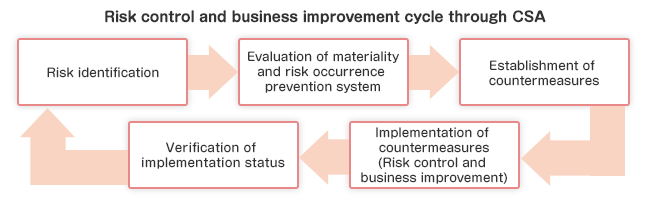
CSA consists of activities that enhance autonomous risk management at each organization and promote risk control and business improvement by implementing the cycle illustrated above, which starts with the identification of risks inherent in business operations. A wide range of risks is covered, including administration risks, system risks, and compliance risks.
Initiatives at head office departments
In the head office departments, key risks are identified for each operation, and their materiality is assessed by considering factors such as the potential impact on customers and the scale of losses in the event that risks materialize, as well as by evaluating the effectiveness of risk prevention frameworks. Based on this assessment, each department develops and implements appropriate countermeasures commensurate with the level of risk, thereby mitigating risks, improving business operations, and promoting sound and appropriate business management.
Initiatives at branch offices
As the operations conducted at each branch office are largely standardized, the identification and organization of risks subject to CSA are carried out by the head office. Each branch office focuses primarily on assessing the effectiveness of risk prevention controls and implementing countermeasures to prevent the occurrence of risks.
Business Continuity Management
Dai-ichi Life has established the Large Scale Risk Management Committee to constantly prepare for the future to ensure that risks are managed individually and that services provided to our customers can be continued even after a major earthquake, other large-scale disaster or a pandemic caused by a new influenza virus.
Specifically, measures are maintained appropriately for crisis management including business continuity planning, and multiple redundancies have been used to backup system and customer data to ensure insurance administrative processes remain working and payouts can be made smoothly even if the head office or branch offices suffer damage. We also provide training and hold drills to achieve continual improvements in our business continuity management.
Following the Great East Japan Earthquake that struck on March 11, 2011, we immediately set up a Disaster Response Headquarters led by the President of Dai-ichi Life, in accordance with our business continuity plan created before the earthquake, and each organization took the time to confirm the safety of employees and to assist damaged branches in getting back up and running in a prompt manner. At the same time, we mobilized Total Life Plan Designers, agents, as well as staff from our branches and head office to check the safety of customers using a company-wide effort and to open temporary contact points for customers in the disaster zone to respond to customer needs locally.
Additionally, in order to stably provide customers with services including payments of claims and benefits and maintain operations even during pandemics of influenza with high levels of contagion, we have established the Pandemic Influenza Countermeasure Action Plan and the Pandemic Influenza Countermeasure Basic Manual to stipulate group-wide measures concerning business continuity, and efforts are also being made to accumulate mitigation materials such as masks and antiseptic solution.
We are committed to continually reinforcing our security measures and preparations for large-scale disasters to further promote business continuity management.